Cravings. What causes them and how to handle them. Part II

This is the second part in a multiple part series on managing cravings. In the first article we talked about the two main types of cravings and how they differ. I also went over when it is best to include these cravings in your diet and when it is best to abstain from them. (You can find the article here) In this article we will go more into the causes of cravings, what is food addictions and how it differs from cravings.  Also, we will go over an exercise to replace your cravings with a new healthy habit.

Cravings are an intense desire for a particular food or taste.  Commonly when I discuss food cravings people bring up food addiction.  Food addiction is when you have an overpowering urge to repeatedly eat something that provides a temporary relief while also having terrible consequences.  For it to be classified as true addiction there also needs to be 3 of the 7 following symptoms: withdrawal, tolerance of the substance over time, eating more than you intend, trying to cut back but can’t, your time is spent pursuing, using and recovering, you miss out on activities or you keep eating these foods despite knowing the consequences.   If this sounds more like what you are dealing with, I urge you to get help from mental health professional. No it doesn’t mean you are weak or don’t have will power.

dsc_0957

Buttery salty popcorn is food many people crave and struggle not to overeat. 

Occasional overeating is not food addiction. You hear people claim to be addicted to everything.  A lot of the time, that is just an uncreative way of saying they enjoy something.  Just because you enjoy something does not mean you are addicted to it. Food addiction is the regular compulsion to eat something knowing that it can harm us.

There are different levels to our food cravings.  From “That sounds tasty” to “OMG I must eat that food” all the way to food addiction. If you would describe your cravings on a scale of 1 to 10 as 7 or higher, then you aren’t just talking about your average cravings and it is important that you get to the bottom of what is causing them.  We all have food we would like to eat. Sometimes that desire is strong, but other times that desire is out of control.

Cravings can be caused by many different things. Here are few things that need to be looked at if you feel you are having unbearable cravings:

Food Variety. Does your diet include enough variety? When people diet, they commonly deprive themselves of foods they enjoy.  They also deprive themselves of variety.  Both of these can led to more cravings.

Are you being too restrictive? Being over restrictive in our diet can cause cravings.  The reward we feel after indulging in our craving is stronger after going through a period of restricting. This is why binges are more common in overly restrictive diets.  One way to handle this is to include small amounts of foods throughout your week to help you feel satisfied.  (Read the 1st article on the series for more on this)

Too low of an overall food intake.  Those cravings can be your body’s way to telling it needs more food.  It can be important to listen to what our body is trying to tell us.  Not only are diets that are too low in calories unhealthy, but also they are hard to stick to for long periods of time. This make them unsustainable.

Your macronutrients (fat, carbohydrate, protein) intake.  We all have different needs for different percentage of fat, protein and carbohydrates.  While your friend may do great with no cravings on a low carb diet, your cravings may go through the roof on it.  Again these cravings are our body’s way of signaling us we need to change the way we eat.  First, make sure you are getting enough protein.  Then, alternate increasing carbs and fat until you find the point where your cravings diminish to a tolerable level. Once you have found your personal macro level, you can slowly decrease one macronutrient at a time, if fat loss is your goal.

Eating too much/too little carbs. As mentioned above, intake is a big reason for cravings.  It not just too little carbs, that can cause this.  Too much carbs can cause an increase in cravings.  Particularly if you are consuming hyper palatable foods.  Hyper palatable foods are foods high in carbs and fat or carbs and salt.  When we eat these foods, instead of feeling satisfied they make us want to eat more.  One reason for this when we consume these foods they stimulate the feel good chemicals in our brain, causing us to want to eat more of those foods while making us feel good.

donuts

Donuts would be considered hyper palatable foods due to their high sugar and fat content.


Not enough protein.  Most people think they are consuming a lot more protein then they really are.  A base amount 1.2 -1.6 g/kg body weight are ideal for optimal health for healthy adults.  (That comes out to 81-109 grams for 150 Lb. person). Athletes and people undergoing intense training and exercise will need more, up to 2-2.2g/kg (For more on protein see this article here)

Enough water and fiber. Both of these can help us feel full and keep hunger and craving down between meals.

water

Water can help with cravings, and not enough water in a day can lead to increase in cravings.

Stress levels. High levels of stress are associated with more intense cravings.  While we can’t always control what is going on in our lives we can control how we recover from it.  Leisurely walks, meditation, yoga, ta chi, reading a book, warm baths, time with friends, playing with a pet and some quality time with your significant other are ways to combat stress.

Lack of sleep. Sleep deprivation can increase appetite and particular cravings for those hyper palatable foods (foods high in carbs and fat or high in carbs and salt) Try turning off the screens and going to bed earlier. If you have a hard time sleeping, you may need to look at your food intake (particularly over all calories and carbohydrates) and your stress levels.  Too low a calorie intake and too low a carbohydrate intake both can affect sleep.

Too much exercise. Over exercising increases cravings.  You do not need to be killing it in the gym for hours 5 days a week. Try replacing some of those sessions with low intensity activities like leisurely walks or restorative yoga (not power or hot!) or short (20 mins or less!) burst of high intensity training and see if that helps the cravings. I generally recommend 3-4 strength based workouts a week plus 1-2 10-20 min high intensity workouts and as much leisurely low intensity activity that you can fit in your day.

Weak satiety response. Satiety is the sensation of feeling full. For some there is a weak response to satiety, meaning they don’t feel full.  This could be caused by leptin resistance or genetics.

Another reason we experience cravings is because we are trying to use foods to replace what is missing in our lives.  We attempt to use food to replace fun, love and control.  Or we use food to try to avoid feeling uncomfortable emotions, like sadness, loneliness and worry. Most of us have inadvertently been taught to reach for food as a way to deal with emotions from a young age. Maybe we were handed a bag of salty snack after a tough day at school, or given a bowl of ice cream after a fight with friends. (Reminder for parents out there, food is not love) After repeatedly reaching for food  as a way to deal with emotions, a habit is created.

broccoli

Why don’t we crave broccoli?

If your cravings are habit based (and you know your nutritional intake is on point) then you can deal with from a mental perspective. Below I outlined a little exercise to help you replace those cravings with a healthier habit. (Again, this is for habit based cravings and not cravings stemming from nutritional inadequacy)

Four steps to mentally handling our cravings.

1)Realizing what your cravings are. Sounds simple right?  You may know what your big cravings are, but there may be smaller ones you are not aware of.  I would give it at least a week. Do nothing but just pay attention to what your cravings are. Ladies, better yet would be to look at your cravings over your entire menstrual cycle. The normal fluctuations in your hormones do effect what you crave and intensity of them.

What do you crave? Is it chocolate?  Salty crunchy tortilla chips? Nut butters? Wine or alcohol? This is the 1st step, just knowing WHAT you routinely crave. You don’t need to do anything else right now.  Just notice and be aware. If you have a journal, write them down. Do not judge your cravings, just accept them. Pay special attention to the type of food you routinely crave; is it salty starchy foods (i.e. chips, pretzels) or high starch high fat foods (like desserts, candy, ice cream) or alcohol?

2.) Now that you know what your cravings are, when do you experience them?  Pay attention to not only what time of day, but what is going on in your life at that moment. Are you sitting in front of the TV at night? Coming home after a LONG day at the office? Maybe you are emotionally upset? Are you tired or stressed? Is it when you are celebrating? Or when you are out with friends?

3.) Identify what it is you really want when you reach for these foods.  What rewards are you really looking for when these cravings hit?  Maybe it has been “one of those days” and what you are really looking for is just to relax.  Or you want to numb out from that emotional or taxing day.  Or you are looking to have fun.  Becoming aware of what the real reward here is key! Do not rush through this step.

Now notice, after you had that pint of ice cream or bag of chips, did you get the reward you were searching for?  Do you actually feel more relaxed? Did you really forget about the bad news?  Or do you feel uncomfortable or angry at yourself? Most of the time, we do not end up getting the original reward we were searching for.

4.) After spending some time doing all this noticing and paying attention, it’s time to do the work. We now want to replace that food craving with a new craving.  I won’t lie, this is the hardest step. Pick your new “craving”.  Some ideas are a bath, a walk, meditation, light exercise, reading, cuddle time with a loved one or playing with your pet. Rest and relaxation type exercises are really good here, since majority of craving are tied to high stress levels.   This will be the hard part.  For 2 weeks, every time the craving hits, notice it. Be mindful of it, but instead of eating or drinking, do your new craving. Eventually that will become your new routine. The time it takes to install this new craving will be different for everyone.  It will partly depend on how long you have been using these foods to try and meet your needs.  We have inadvertently trained ourselves to believe we need the food or drink we crave in order to reach our goal (of numbing out, relaxing, etc.). We don’t, however, it’s just a habit we created.  And we can create a new one.

There is a direct correlation between our moods and our cravings.  Commonly we try to manage our moods with foods.  If we can change the habit of eating the food with something else, we create a new healthy habit.

Cravings run the gamut from “Man, that is something that sounds delicious” to true food addiction. It is important you differentiate between the two before trying to manage them. Cravings can be caused by a handful of things.   Before you try to change them or white knuckle your way through them, you need to address a few things like your food intake, stress levels, recovery and exercise amounts.  With some work and mindset, you can deal with habit based cravings.  Our cravings do not need to run our lives.


References

Dalton, M. H. (2015, Sept). Weak Satiety Responsiveness Is a Reliable Trait Associated with Hedonic Risk Factors for Overeating among Women. Nutrients, 7(9), 7421-7436.

Hill, A. (2007, May). The psychology of food craving. Proc Nutr Soc, 66(2), 277-85.

Kenny, P. (2011, Feb). Reward Mechanisms in Obesity: the new insights and future direction. Neuron, 69(4), 664-79.


hayes-com

Raising Healthy Eaters

Lately, I have been having a lot of people tell me that their children are the reason that they cannot eat healthy.  “I can’t eat that because my child won’t eat it” or “My children have to have the goldfish. And I just can’t control myself when those snacks are in the house”.  Part of our jobs as parents is to help our children become healthy eaters. Having two picky eaters myself, I know how unbelievably frustrating it can be to get them to eat healthy.  Now, while we cannot make our children be healthy eaters, but we can help them learn to make healthy decisions. Instead of letting our children keep the whole family from eating healthy, let’s make this a family affair and work on eating healthy together. Below are some tips for encouraging your kids to make better food choices and in turn eat better yourself.

img_0236

No Clean Plate Club

First off, absolutely DO NOT make your children finish their plate. I know how tempting it is to tell them they need to eat all their food, especially when you just spent the last hour making it.    When we force a child to finish their plate, however, they do not learn proper self-restraint around food. Researchers found preschoolers, whose parents forced them to clean their plates, did not learn self-control of food amounts.  One study showed that children who had been made to clean their plate at home, would request twice the amount of food when away from home.[1]  Trying to use force to get kids to do things sets us up for a power struggle. The last thing you want is to be part of a bartering match at the dinner table.  Anyone who has attempted to barter with a child knows it’s hard to win.  Instead, ask them to check in with themselves while reminding them once this meal is over, there will not be food again till the next snack or meal time.  For a younger child you might ask “Check in with your tummy.  Is it full? Remember once breakfast is over, we won’t have food again till we get home from the library.” They may get it wrong sometimes and not eat enough, but that is ok. That is how they will learn their own internal fullness cues.

No Bribes.

Do not use food bribes to get your child to eat other food.  None of the “I’ll give you dessert/ fruit if you eat all your whatever it is that you clearly don’t want to eat.” Instead just encourage them to taste the offending food.  Explain they do not have to eat it; they just have to taste it.  For young children you can ask them to lick or kiss the broccoli (or whatever the offending object might be).  Generally, the sillier you make it, they more likely they will give it a go. The more exposure they get to different foods (even ones they do not like now) the more likely they are to eat them later on.

Things do taste different to them.

Ever wondered why things you hated as a kid you like now?  Things really do taste different to children.  Children can have up to two times more taste buds then adults. This makes food taste stronger to them. Keep this in mind when you are flabbergasted that they don’t like your delicious dinner.  So be respectful, encourage them to taste it and leave it at that. Just because they do not like something now, doesn’t mean they will always dislike it. Keep offering the offending foods and one day you may be surprised.

Offer something they do like.

When you plan dinner, make sure it has at least 1 thing that everyone likes.  Include one food option that you know each child will eat. That might mean there is chicken for Betty, sweet potatoes for Sam, and peas for George, or whatever the dynamic in your house is. In our house this means there is always sweet potato or white potato, plain meat, a bland veggie and plenty of ketchup. Worst case scenario, there is at least one thing for each of them and everyone will eat something even if it isn’t the balanced perfect meal you envisioned. Remember though, keep offering different foods.  If they hate broccoli now, do not quit offering broccoli.  A lot of children do not like to try new or unfamiliar foods.  (Which is good thing, anthropomorphically it kept us surviving as a species. Imagine if our early ancestors’ children ate anything and everything they came across? Poisonous berries or mushrooms? Uncooked meat?) Kid’s preferences can change.  Just because they don’t like something today doesn’t mean they will continue to dislike it down the road. My kids commonly go through an “only meat phase”, or the ever painful “it has to be orange phase”, but these phases pass and they move on (sometimes to an even more annoying phase).  Just no fuss when they do turn up their nose at something, which is difficult when you just spent all afternoon making what was once their favorite food.

The Snack time hold out.

Some kids will learn that they are given more exciting foods at snack time and will hold out for them.  Ever notice your kid is never hungry at mealtimes but when snack time come around they can pack it away? The easiest fix for this? Get rid of the snacks. This is especially key if your child’s snacks are a trigger food for you.  (A trigger food is a food that you have a hard time controlling yourself around.) For the snack time, you can try offering what was left over from the prior meal. When they don’t finish a meal wrap it up and put it aside.  When “snack time” rolls around, offer them the previous meal.  Only do this, however, if you know the meal offered was something they like. You don’t want to try and trick your kids into eating foods they don’t like.

Kids will not starve themselves.

Studies show anywhere for 10 to 50% of parents believe their child is a picky eater, however majority of those children continue to grow and mature at a normal rate.[2] If, however you are worried there are red flags, go meet with your pediatrician express your concerns and have them show you your child’s growth curve.  Most likely your Dr. will reassure you that your child is still growing ok.

Keep them involved

img_0293

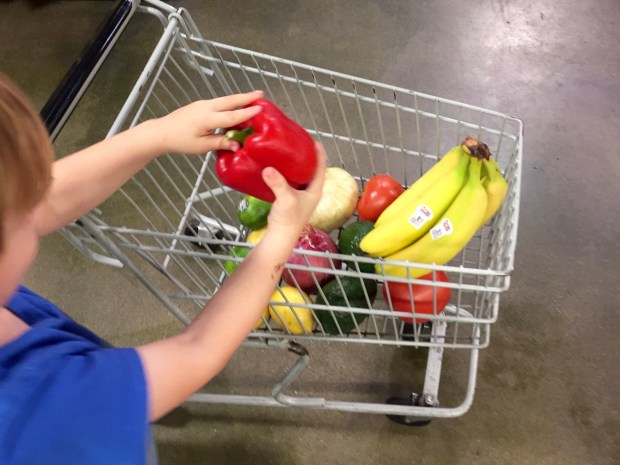
A brave shopping trip with my youngest and the “cart of doom”.

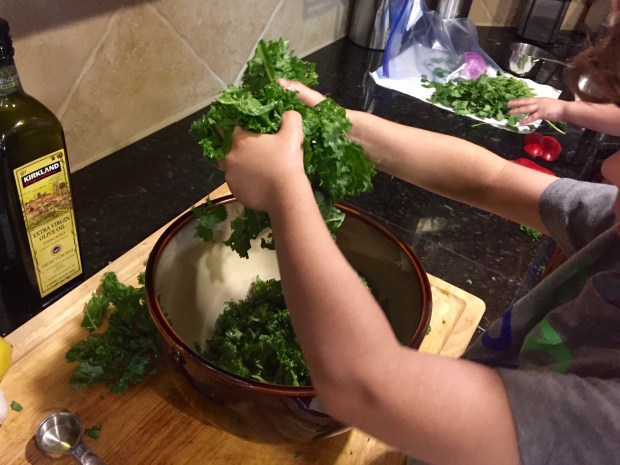
Let the kids help pick out the meals.  Ask them if they have any requests for meals. Then let them help make the meal.  They can assist you in finding the ingredients at the grocery store. I know, shopping with kids is a nightmare, so you might as well give them a job to do and keep them occupied. If you are feeling really patient, let they use those miniature kid carts (or as I call them the “the miniature carts of doom”) Also, let them assist in preparing the meal.  Depending on the age they can help up put together a salad, stir, add ingredients to a pan or bowl, or even start chopping food. Not only will they enjoy spending time with you, but they also are more likely to try the foods if they had a hand at helping to make them. Just stock up on a lot of paper towels and have the broom nearby.

img_0331

My kids helping make a salad for dinner.  They didn’t eat it much of it, but they tasted it.

Don’t let them see you sweat.

While they can’t really smell fear (or can they? Mine seem like they pick up on my apprehension quickly) they are watching us like a hawk. Children learn from observing us. They learn how much to eat, what to eat, if they should try new foods, and how fast they should eat.  Make sure you are setting the best example you can.

Food is not love.

Feeding our children is nurturing act, and the line between food and love can get blurred.  Sometimes, parents give children extra food and treats in order to obtain affection.  You may also see this when extended relatives, like Grandparents, visit. This can lead to a very unhealthy relationship with food. Both the child and the parent can become dependent on this relationship of giving extra food and treats to get more affection. Love is love. Food is not. Use empathy and affection to show love, not food and treats.

Healthy eating is a lifestyle not a diet. By involving the whole family everyone is more likely to succeed in the long run. Not only will you raise healthy eaters but you will maintain your goal of living a healthier lifestyle.  Plus, you are setting up your child with important food skills that will last them a lifetime. By involving everyone in the planning and prep, by not pushing or bribing, by respecting taste differences and offering different foods you are setting your children up with a lifetime of healthy habits.  When the whole family is on a mission together everyone is more likely to succeed.  It won’t always be easy, but really what about parenting is easy?

References

[1] Brian Wansink, P., Collin Payne, P., & Carolina Werle, P. (2008). Consequences of Belonging to the “Clean Plate Club”. Arch Pediatr Adolesc Med., 162(10):, 994-995.

Brown CL, P. M. (2016, Nov – Dec;). Maternal Concern for Child Undereating. Acad Pediatr., 777-782.

Christina Ong, K. Y. (2014, April). Managing the ‘picky eater’ dilemma. Singapore Med J.(55(4)), 184–190.

Robert A. Pretlow, R. J. (Br J Nutr., September). Similarities between obesity in pets and children: the addiction model. Br J Nutr., 116(5): , 944–949.

[2] Wright CM, P. K. (2007, october). How do toddler eating problems relate to their eating behavior, food preferences, and growth? 120(4, 1069-75.

Meal Planning 101

What if I told you there is one very simple thing you can do that can help you stick to a healthier lifestyle? And it also saves money and time? There is, and it’s the act of planning out your meals for the week or any given period of time. I personally meal plan for Monday through Thursday and then again later in the week for Friday through Sunday.

img_0057

When you take the time to sit down and plan out your menu for the week, you are less likely to make last minute unhealthy choices.  It can also help with those impulse buys.  The sweets or salty treats are less likely to find their way into your cart when they are not on the list.  Also, by having your dinners planned out for the week, you are less likely to find yourself ordering pizza at the last minute because “OMG its 6 and what are we going to have for dinner?!” (Yes we have ALL been there! But the end goal is to limit the amount of times that has to happen).  Incorporating variety is easier when you’ve planned the meals out in advance. There is nothing worse than eating chicken breast for 5 days straight.  Blah!

img_0056

Where to begin:

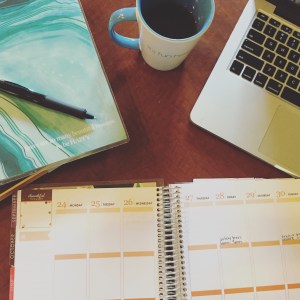
  • First, pour yourself your favorite hot beverage (ok not a necessity but helpful and delicious).  Also if meal planning is something you dread, it can help to pair it with something you enjoy (for me that is a perfect cup of hot coffee, or maybe a matcha latte.)
  • Grab your favorite pen, notebook and planner (if you are old school like me and still use a paper planner).
  • Next, you need to take stock of your kitchen.  I like to sit at my kitchen table when I plan. It helps to be close to the fridge and pantry for easy double checking on ingredients.
  • Find your inspiration. Grab your favorite cookbooks and open your browser to some cooking websites.  Great ones are Skinnytaste (her new cookbook, Fast and Slow, is pretty great), Clean Eating Magazine (and their website, however their website tends to be glitchy for me) and Cooking Light (both magazine and website).
  • Eating healthy can get expensive. Pull up your grocery stores sales flier online and check if there are any great sales (For example my store happened to have some good bargains on meat this week, so I planned my meals around them).
  • Pick your proteins.  It is helpful to first pick out your proteins and then plan your meals around them.  I usually like to try have 2-3 poultry based meals, 1 red meat, 1 pork, 1 fish/shellfish and 1 meatless.  That way we get a variety, no one gets bored and everyone’s favorite gets served.
  • If you load your carbohydrates around your workouts, it’s a good idea to figure out in advance what days you plan to work out so you can plan your carb heavy meals accordingly.
  • After you’ve picked out your recipes and meals, make a list of what you need and head off to the store.  I find it helpful when I write my list to keep everything in categories.  Since the produce section is the first section I hit, all the fruits and veggies are first.  Then it’s the meat counter, dairy section and anything I might need in the aisles.  That way I am not roaming up and down every aisle being tempted by the all the goodies.

Do you meal plan in advance? Any favorite tips of tricks?  If you are still confused, and don’t know what type of recipes to be looking for what you should be putting in your cart fill out a contact form and we can start working together.


My Why.

keep-itI have been sitting here with writer’s block for days.  How do I put “why I started this business” into words?  Then I remembered my motto, “Keep it simple, don’t over complicate.” It applies to nutrition, to writing, to parenting, to everything really.

So, here is my why, and it is simple. . . I like it. I like helping people (INFJ here!) I thrive on it.  I want to help others not only reach their physical goals, but also learn to love themselves in the process.  There is no hating yourself lean here (spoiler alert, that doesn’t work anyways). Now don’t get me wrong, I enjoy the geeky science stuff too.  More than that, however, I enjoy applying the geeky science stuff to the everyday and then teaching that to others.

There is so much information out there, and now with the world at our finger tips, it is easier than ever to get overwhelmed and confused.  Most of the time what works for one person (your BFF, blogger on your newsfeed, or guru on the morning talk show) may not work for you.  We are all different with different needs and different genetics. I want to help people navigate through the over supply of information and work with them to find out what work for them.

Most diets and lose weight quick schemes fail.  They fail because not only are they unsustainable for a long period of time, but also because they are addressing only one piece of the puzzle.  By learning new healthy eating habits, one at a time. You will learn how to choose the healthiest option and not hate it.  This is a lifestyle, not a diet.

I have taken my knowledge and applied it to how you can eat to reach your goals. This can be done without removing entire food groups from your diet. You still get to eat the foods you love (just in moderation).   Your goals are achievable without crash diets, tons of supplements, or working out till you puke. And, for the record, I do not believe in bad foods.

By learning some healthy habits and the proper mindset you can not only achieve your goals but maintain them. And I want to help you do that!

So, that is my why.  What is yours?